Testing
Testing
How the SDK test suite is structured and how to write tests for your agents.
Fixtures, factories, and mock builders are documented on Test Tooling.
Strategy
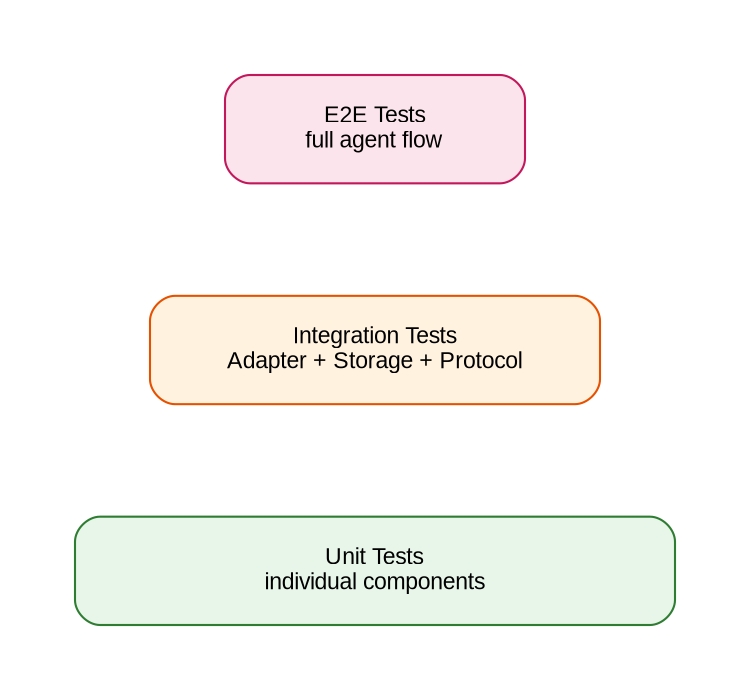
| Component | Test type | Focus |
|---|---|---|
| Agent | Integration | get_pipeline_adapter(), storage flow, as_view() |
| Stream / Run | Integration | Event emission, ID generation, tool calls |
| Storage | Integration | CRUD, rating, history, ThreadService |
| Protocol | Unit | Message conversion, event → part mapping |
| RAG | Unit + Integration | Warmup, caching, retrieval, concurrency |
Principles:
- Mock external services: never call a real model provider or a real Qdrant in tests.
- Use MemoryStorage: fast, isolated; DB tests opt in with
@pytest.mark.django_db. - Test event flow: verify the event sequence of
Stream.stream(). - Test ID consistency: the
message_idfromMessageStartEventmust appear in storage. - Async everywhere:
asyncio_mode = "auto"lets pytest detect async tests.
Setup
make setup      # runtime + demo extras only
make setup-all  # every extra, including the torch-based transformers stack
Pytest config (pyproject.toml):
[tool.pytest.ini_options]
DJANGO_SETTINGS_MODULE = "tests.settings"
asyncio_mode = "auto"
testpaths = ["tests"]
pythonpath = ["."]
python_files = ["test_*.py", "*_test.py"]
python_classes = ["Test*"]
python_functions = ["test_*"]
Running Tests
# Everything
make test
# equivalent: uv run pytest tests -v

# A single file
uv run pytest tests/integration/test_protocol_handlers.py -v

# A single test
uv run pytest tests/unit/test_thread_service.py::test_something -v

# Debug
uv run pytest -x
uv run pytest --pdb

# The demo projects' own tests (each demo in demos/ runs with its own settings)
make test-demos
tests/settings.py is a minimal Django project: the SDK apps, an in-memory SQLite
database, and tests.testapp with an email-only User (no username field, like many
host projects). It never imports from demos/. Tests that depend on a specific
permission class set it themselves (see tests/mocks/permissions.py).
Test Structure
tests/
├── settings.py          # minimal Django settings for the suite
├── urls.py
├── testapp/             # email-only User model
├── conftest.py          # shared fixtures, session event loop
├── factories/           # polyfactory-based model factories
│   ├── db.py            # Django ORM factories
│   └── schemas.py       # Pydantic factories (ChatMessageFactory, ...)
├── mocks/               # reusable mock builders
│   ├── agent.py         # create_agent_mock()
│   ├── integrations.py
│   ├── permissions.py   # permission patch helpers
│   ├── registry.py
│   └── storage.py       # mock storage adapters & threads
├── unit/                # component tests (no DB)
│   ├── test_haystack_bm25.py
│   ├── test_rag_provider_concurrency.py
│   ├── test_thread_service.py
│   └── ...
└── integration/         # end-to-end component tests
    ├── test_base_agent.py
    ├── test_protocol_handlers.py
    └── test_storage_adapter.py
Common Patterns
Verify the event sequence
async def test_event_sequence():
    events = [e async for e in stream.stream([ChatMessage(role="user", content="Hi")])]
    assert isinstance(events[0], MessageStartEvent)
    assert isinstance(events[-2], MessageEndEvent)
    assert isinstance(events[-1], StreamEndEvent)
Verify ID consistency
async def test_id_consistency():
    message_ids = []
    async for event in stream.stream([ChatMessage(role="user", content="Hi")]):
        if isinstance(event, MessageStartEvent):
            message_ids.append(event.message_id)

    stored = [m for m in await storage.get_messages() if m.id == message_ids[0]]
    assert stored, "stored message shares the SSE message_id"
Verify error handling
async def test_stream_error():
    # Generator raises mid-stream → ErrorEvent emitted, stream still ends
    events = [e async for e in stream.stream([ChatMessage(role="user", content="Hi")])]
    assert any(isinstance(e, ErrorEvent) for e in events)
    assert isinstance(events[-1], StreamEndEvent)
RAG provider concurrency
test_rag_provider_concurrency.py verifies that concurrent warmups for the same memory key are serialized by the per-key lock and produce a single cached instance:
async def test_concurrent_warmup_single_instance():
    provider = RAGProvider()
    results = await asyncio.gather(*[
        provider.warmup(agent, "mem-1") for _ in range(5)
    ])
    assert provider.get_cached_rag_instance(agent, "mem-1") is not None
Permission-aware thread services
ThreadService methods raise PermissionDenied when the user lacks access:
async def test_denied(user_without_perms):
    with pytest.raises(PermissionDenied):
        await ThreadService.get_thread(thread_id, user=user_without_perms)
Next: Test Tooling, fixtures, factories, and mocks.