RAG
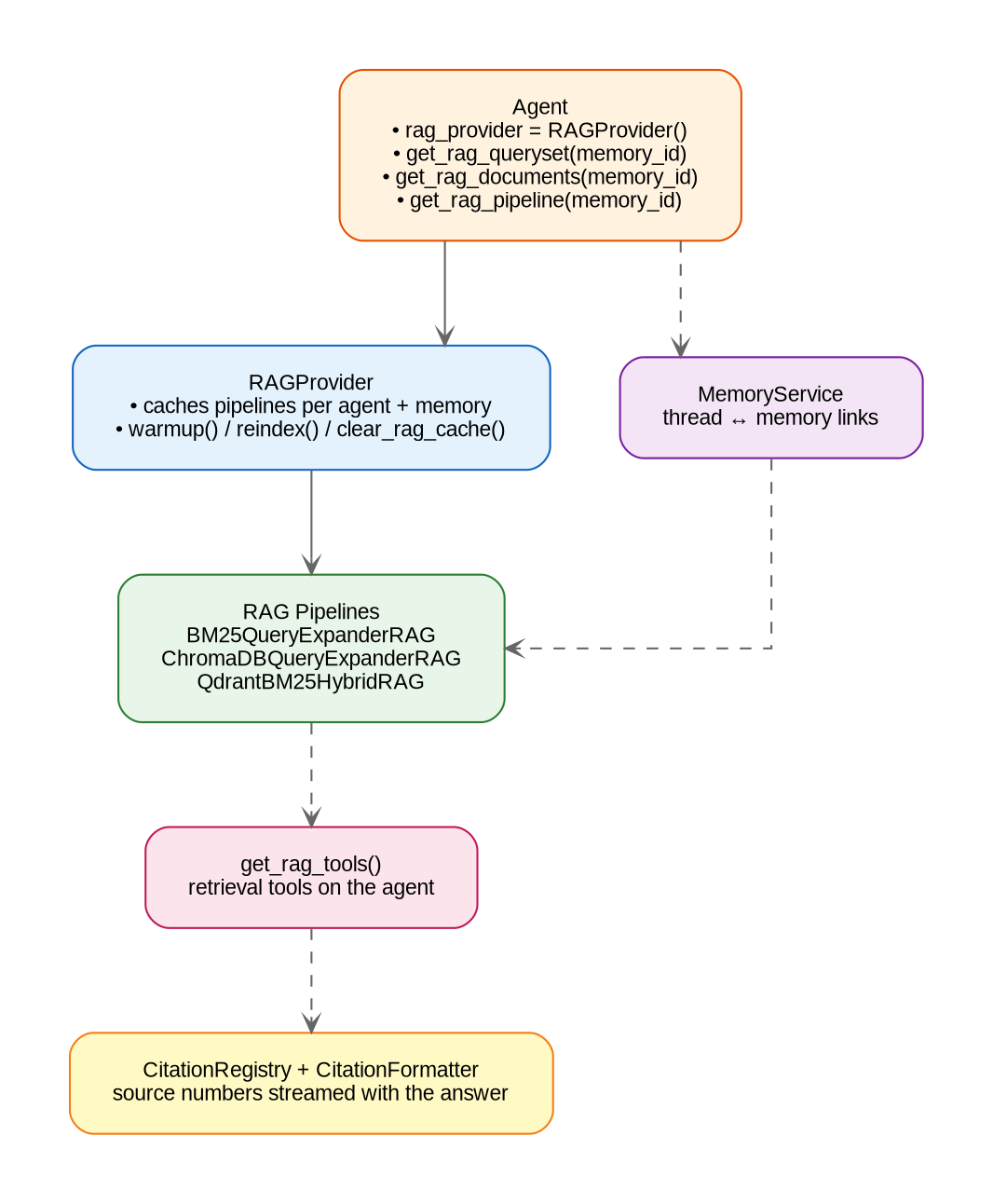
How RAG works in the SDK: the provider lifecycle and how retrieval is exposed to agents as tools.
What is RAG?
Retrieval-Augmented Generation grounds the model in facts:
- User asks a question
- Agent retrieves relevant documents from a memory
- Documents pass back to the model as retrieved context
- Model responds, citing numbered sources
Enabling RAG on an Agent
Set the provider
Set rag_provider = RAGProvider() on the agent.
Return the documents
Override get_rag_queryset() (and/or get_rag_documents()) to select what gets indexed.
Return a pipeline
Implement get_rag_pipeline() (or one of the named variants) to return a RAG pipeline.
Link memories to threads
get_rag_tools() builds one retrieval tool per active memory.
from django_ai_sdk.memories.models import Entry
from django_ai_sdk.rags import BM25QueryExpanderRAG, BM25QueryExpanderRAGConfig
from django_ai_sdk.rags.provider import RAGProvider

class MyAgent(Agent):
    rag_provider = RAGProvider()

    async def get_rag_queryset(self, memory_id=None):
        if memory_id:
            return Entry.objects.filter(memory_id=memory_id)
        return Entry.objects.all()

    async def get_rag_pipeline(self, memory_id=None):
        documents = await self.get_rag_documents(memory_id)
        if not documents:
            return None
        return BM25QueryExpanderRAG(
            documents=documents,
            config=BM25QueryExpanderRAGConfig(top_k=5, n_expansions=4),
        )
Wire the retrieval tools into the ToolAgent inside get_pipeline_adapter():
async def get_pipeline_adapter(self, thread_id=None, user=None):
    generator = self.get_llm()
    citation_registry = self.get_citation_registry()

    rag_tools = await self.get_rag_tools(
        thread_id=thread_id,
        citation_registry=citation_registry,
        citation_formatter=self.get_citation_formatter(),
        user=user,
    )
    tool_agent = ToolAgent(
        config=ToolAgentConfig(
            model=self.get_model(),
            system_prompt=self.get_system_prompt(),
            tools=[*await self.get_tools(thread_id=thread_id, user=user), *rag_tools],
        ),
        generator=generator,
    )
    return Stream(
        pipeline=tool_agent.pipeline(),
        generator=generator,
        storage_adapter=await self.get_storage_adapter(thread_id),
        citation_registry=citation_registry,
    )
RAGProvider
RAGProvider manages the RAG lifecycle: warmup (building indexes), an LRU cache of instances (_MAX_CACHE_SIZE = 100), and conversion of pipelines to tools.
| Method | Purpose |
|---|---|
warmup(agent, memory_id, force_rebuild=False) |
Build indexes via get_or_create, then cache the RAG instance |
get_rag_instance(agent, memory_id) |
Return the cached RAG, creating + warming it if absent |
get_cached_rag_instance(agent, memory_id) |
Return the cached RAG without touching the store (safe when a second connection would conflict, e.g. Qdrant’s exclusive local lock) |
get_tool(agent, memory_id, *, spec, citation_registry, citation_formatter) |
Build a ComponentTool with optional citation wiring |
build_tool(rag_instance, *, spec=None) |
Wrap a RAG instance as a ComponentTool (get_tool(spec) with a spec, else as_tool()) |
add_documents(agent, memory_id, documents) |
Incrementally add documents to an existing index |
remove_documents(agent, memory_id, document_ids) |
Incrementally remove documents from an existing index |
reindex(agent, memory_id, force_rebuild=False) |
Drop the cache entry and rebuild (returns the new instance) |
clear_cache() |
Drop all cached RAG instances |
asyncio.Lock: concurrent requests for the same memory don’t double-build (important for backends like Qdrant that hold an exclusive file lock during warmup). A warm cache returns without acquiring any lock.Integration: Tool Calling
RAG is exposed as a per-memory retrieval tool the model decides to call: there is no automatic context injection. Each memory linked to the thread produces one tool named after its ToolSpec:
spec = await memory.get_tool_spec() # -> ToolSpec(name="search_documents", ...)Tool names are namespaced per memory so unrelated memories don’t collide; if two memories produce the same name, the later one is suffixed with a short memory-ID hash and a warning is logged. Memories with zero documents are skipped with a warning. Retrieval results stream back as numbered SourceEvents.
Citations
Retrieved sources are rendered to the model as numbered citations and streamed to the frontend:
get_citation_registry(): a fresh per-turnCitationRegistryso indices reset between turns.get_citation_formatter()/citation_formatter_class: how sources render for the model.DefaultCitationFormatternumbers sources so the model can reference them inline.Streamemits aSourceEvent(index, title, content, source_id, ...)per source after a retrieval tool runs, in cumulative-index order.- Protocol handlers translate these into the frontend’s citation format (Vercel
source-documentparts carry the citation index inproviderMetadata).
Wire the same registry and formatter into both get_rag_tools() and the Stream so citations round-trip consistently.
Lifecycle
| Action | Where | Effect |
|---|---|---|
| Warm up | Agent.warmup(agent, memory_id) (classmethod) |
Pre-builds and caches pipelines; no-op without a provider |
| Auto warm up | warmup_on_init = True |
Schedules rag_provider.warmup() on instantiation |
| Reindex | Agent.reindex(agent, memory_id, force_rebuild) |
Drops the cache entry and rebuilds; persistent backends (Qdrant) delete and recreate |
| Clear cache | Agent.clear_rag_cache(agent) |
Drops all cached instances |
| CLI | python manage.py warmup_rag --agent <name> |
Warms up from the command line (CLI) |
await MyAgent.warmup(agent, memory_id="mem-1")                 # build once
await MyAgent.reindex(agent, memory_id="mem-1")                # rebuild
MyAgent.clear_rag_cache(agent)                                 # drop cache
Best Practices
| Practice | Why |
|---|---|
Route through the provider (get_rag_instance) |
Avoids rebuilding the index on every call |
Use get_cached_rag_instance() with Qdrant |
Its local file lock is exclusive, so reuse the warmed instance |
Return None from get_rag_pipeline() with no documents |
Provider caches None; get_rag_tools() skips the memory cleanly |
Set top_k to match your context budget |
1 risks missing context; 50 floods the window. Start at 5 |
| Reindex after document changes | Or use incremental add_documents() / remove_documents() |
Next: Storage, where conversations persist.