ID Generation
ID Generation
How a single message_id flows from generation → SSE → storage → later operations.
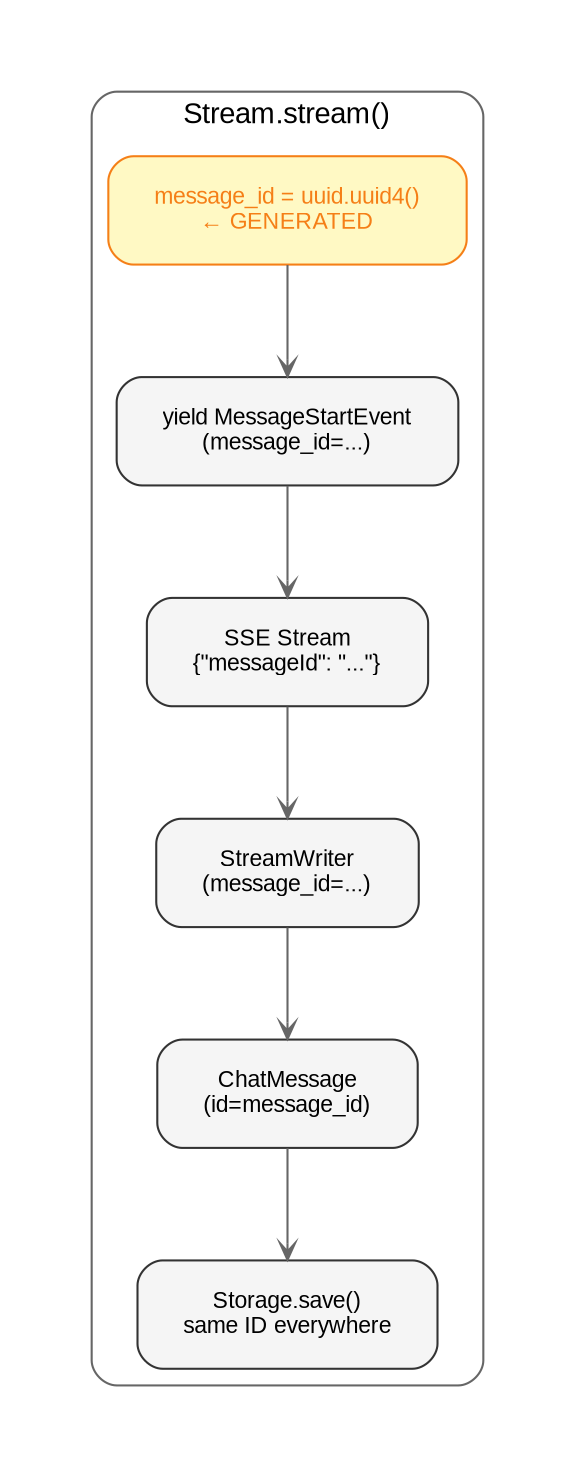
The message_id is generated once in Stream.stream():
Stream.stream()
    ↓
message_id = str(uuid.uuid4())  # Generate once
    ↓
yield MessageStartEvent(message_id)  # SSE: {"messageId": "..."}
    ↓
StreamWriter(message_id=message_id)  # Storage callback
    ↓
ChatMessage(id=message_id)          # Persisted message
    ↓
Rating / delete / restore endpoints use the same ID
This is what lets the frontend track the message it renders while the backend rates, deletes, or restores the same record.
StreamWriter
When store=True and a storage_adapter is provided, Stream creates a StreamWriter bound to the message_id. As chunks stream in, stream_writer.add_chunk(...) accumulates them:
writer = StreamWriter(message_id=message_id, role="assistant")
writer.add_chunk(MessageChunk(type="text", content="Hello"))
writer.add_chunk(MessageChunk(type="text", content=" world"))
MessageChunk types: text, reasoning, tool_call_start, tool_input, tool_output, error.
Finalize
On completion, Stream.get_final_message():
- Persists citation sources (reference fields only:
index,title,source_id,memory_id,page_number; content is resolved fresh from the store). - Calls
stream_writer.finalize("stop"), which invokesstorage_adapter.storage_callback(...)to save the message.
The result is available as stream.message_result.
Citations & Suggestions Wiring
- With a
citation_registry,Streamemits aSourceEventper registered source after a retrieval tool runs, in cumulative-index order.source_idisdoc_idordoc_id:chunk_id. - With
suggestion_generator,Streamgenerates follow-up questions after the reply using the last six messages and the response. Generation runs underAI_SDK_SUGGESTION_TIMEOUT(default 5s); timeouts and errors are logged and skipped, never fatal.
Next: Protocol Handler, converting events to wire format.