Agent
Deep dive into the Agent class: what it configures and which hooks the SDK calls.
Responsibilities
The Agent is the coordinator. It:
- Declares AI personality:
name,model,instructions - Picks a protocol handler and a storage adapter
- Provides the adapter hooks
Stream/Runare built from - Exposes lifecycle hooks for RAG warmup, citations, and suggestions
Configuration
Key class attributes (full table in the Agents guide):
| Variable | Default | Purpose |
|---|---|---|
name |
None | Display name |
model |
None |
Model identifier passed to the generator |
llm |
openai_responses_chat |
Generator factory, assigned uncalled |
llm_kwargs |
None |
Vendor generation parameters for that factory |
instructions |
built-in prompt | System prompt, built with prompt() |
protocol |
VercelProtocolHandler |
Wire-format handler class |
storage_adapter |
MemoryStorageAdapter |
Fallback storage class |
tools |
[] |
Class-level tool providers |
integrations |
[] |
Integration names whose tools reach this agent |
artifacts |
[] |
ArtifactSchema subclasses exposed as submission tools |
rag_provider |
None |
RAGProvider instance for RAG |
memories |
[] |
Default connected memories |
max_history |
None |
Cap on messages sent to the model |
response_format |
None |
Pydantic model for structured run() output |
title_generation |
True |
Auto-generate thread titles |
permissions |
None |
Permission classes gating operations; None or [] uses the agent domain default |
warmup_on_init |
False |
Warm up RAG on instantiation |
hidden / abstract |
False |
Registry behavior flags |
Agent.__init__ instantiates self.protocol() into self.protocol_handler.
Adapter Hooks
The SDK calls two abstract hooks; you implement them:
| Hook | Returns | Used by |
|---|---|---|
get_pipeline_adapter(thread_id, user) |
Stream |
Agent.as_view() (streaming chat) |
get_run_adapter(thread_id, user) |
Run |
Agent.run() (titles, extraction, jobs) |
async def get_pipeline_adapter(self, thread_id=None, user=None):
    generator = self.get_llm()
    tool_agent = ToolAgent(
        config=ToolAgentConfig(
            model=self.get_model(),
            system_prompt=self.get_system_prompt(),
            tools=await self.get_tools(thread_id=thread_id or "", user=user),
        ),
        generator=generator,
    )
    return Stream(
        pipeline=tool_agent.pipeline(),
        generator=generator,
        storage_adapter=await self.get_storage_adapter(thread_id),
    )
A worker-only agent (hidden = True, never in chat) can leave get_pipeline_adapter() unimplemented.
Storage Resolution
get_storage_adapter(thread_id) queries all registered adapters for the thread and returns a bound instance, falling back to the agent’s storage_adapter. See Storage.
Tool Assembly
get_tools(thread_id, user) combines, in order:
- Class-level
toolsproviders (each called withthread_id/userkwargs) - Integration tools (
integrationslist) - Artifact submission tools (
artifacts) - Subagent agent tools (
agentslist — oneComponentToolper subagent)
get_rag_tools(thread_id, user) appends one retrieval tool per active memory when rag_provider is set. See RAG.
Subagent Delegation
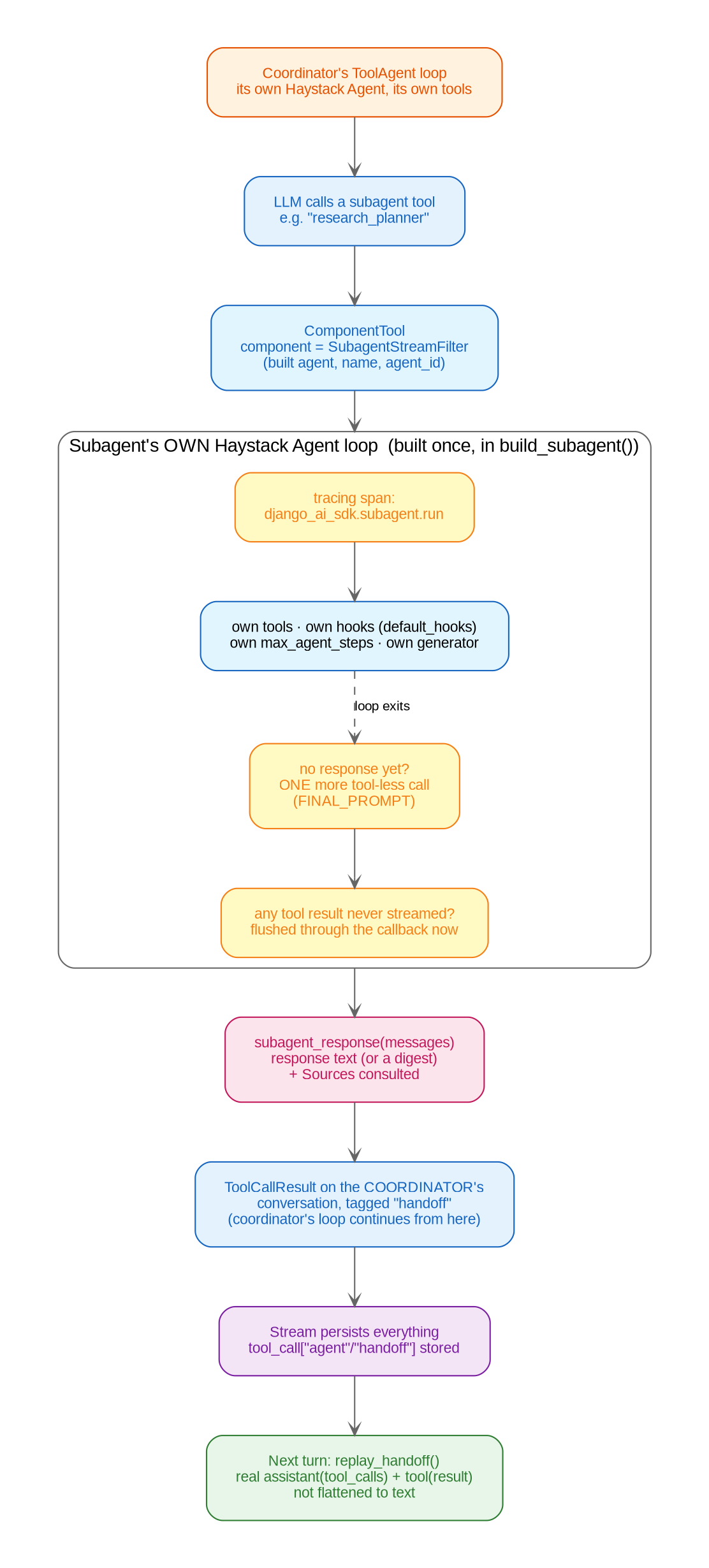
Declaring agents = [SubagentA, SubagentB] on an Agent turns each subagent into a delegate-able Haystack ComponentTool. Only plain Agent subclasses can appear in that list — a RuntimeAgent (DB-configured) never can, since its __init__ requires an AgentSettings row and agents = [...] holds bare classes with no way to pass one in. hidden = True on a subagent is a convention, not an enforcement.
get_agent_tools(thread_id, user)builds them, per class inself.agents:- Cycle guard, declaration-level. Skip
subagent_cls is self.__class__(no self-delegation) and any class path already seen this call. - Permission check.
AgentService.has_perms(user, Operation.VIEW_AGENT, agent=subagent_cls)— skip onPermissionDeniedrather than failing the whole tool list. - Build it.
build_subagent(subagent_cls, thread_id, user)→(HaystackAgent, agent_id), orNonefor a cyclic graph (see below). - Name the tool.
subagent_tool_name(subagent_cls)slugifies the display name. A collision appends a short suffix derived from the colliding class’sagent_id(research_planner_7f3a2c) — guaranteed not to collide again, unlike an incrementing counter; the same patternget_rag_tools()already uses for a memory-tool-name collision. - Wrap it as a
ComponentToolscoped to a singletaskstring parameter — delegation, not remote tool invocation.
- Cycle guard, declaration-level. Skip
build_subagent(cls, thread_id, user)(indjango_ai_sdk.agents.subagent) builds the subagent with its own generator/tools/prompt plus ataskuser-variable. A second cycle guard here — aContextVartracking the chain of classes currently being built on this asyncio task — catches a graph cycle the declaration-level check can’t (A delegates to B, B delegates to A, several hops apart). Loop limits and hooks come fromdefault_hooks(subagent)(agents/tool_agent.py): alwaysLogToolCallsHook, plusToolCallBudgetHook(subagent.max_tool_calls)when that’s set (default6;Nonedisables the cap), andmax_agent_steps=subagent.max_agent_steps(default6). This is the same functionAgent.run(tools=True)uses for a headless run — a subagent class is governed identically whether it’s delegated to live or run by itself.- The subagent’s response becomes the tool output via
outputs_to_string— see Handoff output for what that contains and how a cut-short run is recovered. The coordinator remains the single source of streamed text, but the subagent’s tool calls/results stream to the client viastream_subagent_tools(default on) and are persisted into the conversation history —SubagentStreamFilterforwards only tool chunks, in the order they happen. - The coordinator’s
get_system_prompt()appends anAvailable subagents:roster.
Handoff output
The tool output the coordinator receives is built from the subagent’s whole conversation, not just its last message. That matters because a subagent can run out of budget or steps after doing the work: reading only the last message would hand back a “you have reached the maximum of N tool calls” notice and throw every result away.
subagent_response() (django_ai_sdk/agents/subagent.py) returns, in order:
- The response — the subagent’s final written answer.
- Sources consulted — one
tool(args)line per call it made, names and arguments only, never bodies. Always appended, so the coordinator can cite even when the response forgot to. - A digest — only when there is no response: the gathered tool results
themselves, under
"The run was cut short before a response was finished."so the coordinator presents them as partial rather than as a finished answer. Capped byAI_SDK_SUBAGENT_DIGEST_LIMIT(default6000characters,0disables), budgeted across all results so one large page cannot crowd out the rest.
Before the digest is reached, SubagentStreamFilter makes one tool-less LLM
call asking the subagent to write its response from what it already
gathered. This is what makes the outcome independent of max_agent_steps
being generous enough to leave a spare step after the tool budget fires. It
runs only on that path, once, and a failure there falls through to the digest
rather than propagating.
ToolCallBudgetHook supports this by answering a call it refuses rather than
erasing it: the pending assistant(tool_calls) message stays and each call gets
a stub tool result. The turn remains well-formed for the chat APIs, no tool
executes, the instruction rides a message the model must read — and the client
sees the call resolve instead of a tool part stuck with no output.
Attribution
Every stored tool call records who ran it, so a coordinator’s own work is never confused with its crew’s:
Key on the stored tool_call |
Meaning |
|---|---|
handoff |
The coordinator delegating to the named subagent. |
agent |
A tool the named subagent called itself (search_web, …). |
| neither | An ordinary tool the coordinator called directly. |
SubagentStreamFilter tags each chunk it forwards with the subagent’s name
(django_ai_sdk.subagent in StreamingChunk.meta); Stream reads that back,
together with the handoff tool names it discovers from the pipeline, and
StreamWriter writes both onto the tool call. Both keys are additive, so
history written before this existed still loads.
This is display attribution by name, on stored tool calls — a separate system
from the tracing span’s agent_id/agent_name columns (see
Subagents in a trace), which exist for
stable lookups and are keyed by id precisely to avoid the name-collision this
system accepts for display.
The same marks reach the browser. The Vercel handler sends them as AI SDK
provider metadata on tool-input-start and tool-input-available, which the
client stores as callProviderMetadata — it survives the transition to
output-available, so tagging the call start labels the whole lifecycle:
{ "providerMetadata": { "sdk": { "agent": "Research Planner" } } }from_chat_messages re-emits it as callProviderMetadata so the label survives
a page reload. A tool the coordinator called itself carries no such key, and its
payload is unchanged.
Handoff history
A subagent’s report comes back as the tool result of the delegation call, and
that is what gets persisted. Replaying only the coordinator’s text would hand
the next turn its own restatement of the report instead of the report, so
Stream.get_messages rebuilds each handoff as the assistant/tool pair it
originally was:
user       "Research Example Company B.V."
assistant  (tool_calls=[research_planner(task=…)])
tool       "Full report: …"          <- the subagent's findings, verbatim
user       "Which city?"
Only calls marked handoff replay. A subagent’s own tool calls stay in history
for the UI and traces but are not fed back to the model — the report already
summarizes them. Each replayed result is capped by
AI_SDK_HISTORY_TOOL_OUTPUT_LIMIT (default 4000 characters, 0 disables) so
one large research turn cannot crowd out the context window.
Because a tool message has to follow its call directly, a handoff message is
never merged into its neighbours; merge_messages applies to the plain-text
runs around it.
RAG Lifecycle Hooks
Classmethods that delegate to rag_provider (no-op without a provider):
| Hook | Effect |
|---|---|
MyAgent.warmup(agent, memory_id) |
Pre-build and cache pipelines |
MyAgent.reindex(agent, memory_id, force_rebuild) |
Drop cache entry and rebuild |
MyAgent.clear_rag_cache(agent) |
Drop all cached instances |
Citations & Suggestions
| Hook | Returns |
|---|---|
get_citation_registry() |
Fresh per-turn CitationRegistry |
get_citation_formatter() |
From citation_formatter_class |
get_suggestion_generator() |
self.suggestion_generator(agent=self) |
Generator
| Hook | Returns |
|---|---|
get_llm(**kwargs) |
A chat generator built by the llm factory (default openai_responses_chat), with this agent’s model and llm_kwargs applied. See Generators. |
Entry Point
as_view(protocol_messages, thread_id=None, user=None):
- Checks
CHATpermissions - Converts protocol messages via
self.protocol_handler.to_chat_messages() - Stores the newest user message when a thread is active
- Builds the pipeline adapter and returns a
StreamingHttpResponse
response = await agent.as_view(payload.messages, thread_id=..., user=request.user)Next: Agent Registry, registration and stable-ID resolution.