Storage
How conversations persist. Conversations are threads of messages; all adapters speak the same ChatMessage format.
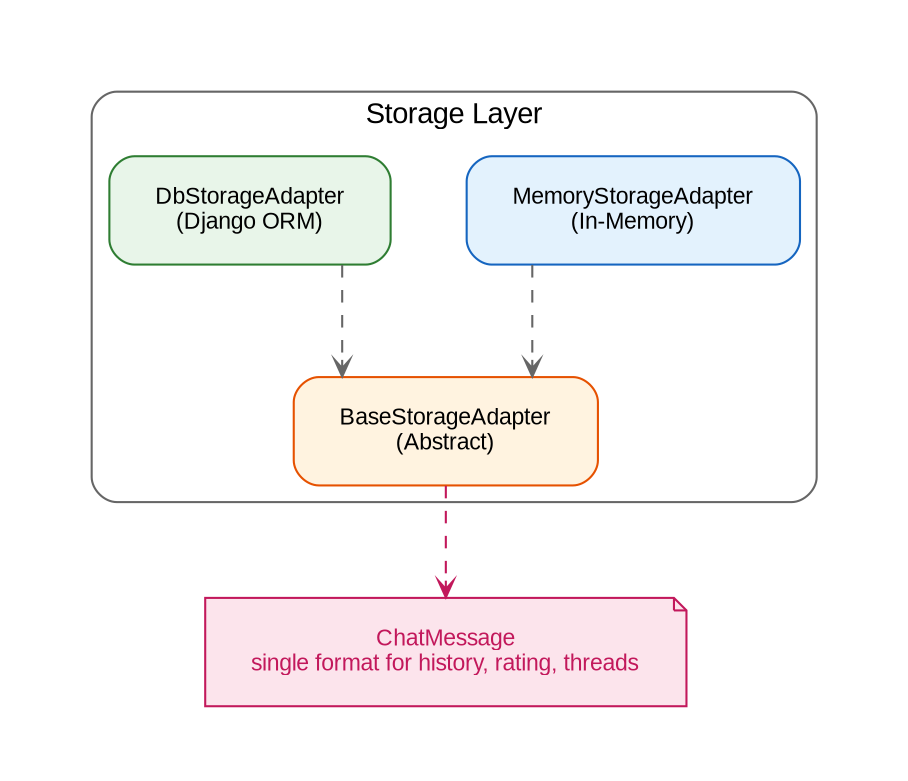
Available Adapters
| Adapter | Persistence | Speed | Best For |
|---|---|---|---|
MemoryStorageAdapter |
In-memory | Fastest | Testing, development |
DbStorageAdapter |
Django ORM | Slower | Production, long-term |
from django_ai_sdk.storage.db import DbStorageAdapter

class MyAgent(Agent):
    storage_adapter = DbStorageAdapter  # or MemoryStorageAdapter
Both use the same format and interface: switching is a one-line change.
The ChatMessage Format
ChatMessage (in django_ai_sdk.common) is the universal message format every adapter persists:
| Field | Type | Description |
|---|---|---|
role |
"system" | "user" | "assistant" |
Message role |
content |
str |
Message text |
reasoning |
str | None |
Model reasoning (when supported) |
id |
str |
Message UUID |
tool_calls |
list[dict] |
Tool calls with id, name, arguments, result |
sources |
list[dict] |
RAG citation references (index, title, source_id, memory_id, page_number) |
model |
str |
Model identifier |
finish_reason |
str |
stop, error, cancelled, … |
errors |
list[str] |
Error messages (when the stream failed) |
metadata |
dict |
Arbitrary metadata (e.g. feedbacks) |
created_at |
str |
ISO timestamp |
processing_time_ms |
int |
Total processing time |
started_at / completed_at |
float |
Unix timestamps |
Helpers: .text (alias of content), .duration, .has_tools, .has_errors, .finalize(finish_reason).
Adapter API
Every adapter implements BaseStorageAdapter (django_ai_sdk.storage.base).
Class methods: thread management
thread_id = await DbStorageAdapter.create_thread(
    title="My Conversation",
    metadata={"agent_id": "..."},   # agent_id should be included
    user=request.user,              # optional owner
)

thread = await DbStorageAdapter.get_thread(thread_id)      # -> ThreadInfo | None
threads = await DbStorageAdapter.list_threads(user=None, limit=100, offset=0)
await DbStorageAdapter.update_thread(thread_id, title="New title")
await DbStorageAdapter.delete_thread(thread_id)            # -> bool
list_threads paginates with limit/offset and returns everything by default (limit=None).
ThreadInfo carries id, title, agent_id, model, user_id, created_at, updated_at, metadata, message_count, file_memory_id.
Instance methods: thread-specific operations
storage = DbStorageAdapter(thread_id)   # bound to a thread

messages = await storage.get_messages()                     # list[ChatMessage]
message_id = await storage.store_chat_message(chat_message) # -> str
await storage.rate_message(message_id, rating=1, feedback="great", user=request.user)
await storage.delete_message(message_id)                    # soft delete
await storage.restore_message(message_id)                   # undo delete
storage_callback
The async storage_callback(chat_message) is what StreamWriter calls to auto-persist streamed replies. Agent.get_storage_adapter(thread_id) finds which adapter actually holds a thread by querying all registered adapters, falling back to the agent’s configured storage_adapter.
How Streaming Persists Messages
Stream.stream()generates themessage_idand creates aStreamWriterbound to it.- As chunks stream,
stream_writer.add_chunk(chunk)accumulates text, reasoning, tool calls, and errors. Stream.get_final_message()attaches citation sources, then callsstream_writer.finalize("stop").finalize()invokesstorage_adapter.storage_callback(message)to persist it.
Failed or cancelled streams persist with finish_reason="error" / "cancelled". The same message_id flows through SSE, storage, and API endpoints: see ID Generation.
Examples
Create a thread and store messages
from django_ai_sdk.common import ChatMessage
from django_ai_sdk.storage.services import ThreadService

thread_id = await ThreadService.create_thread(agent_id, title="Pirate Conversation", user=request.user)
storage = await ThreadService.storage_for_thread(thread_id, user=request.user)

user_id = await storage.store_chat_message(ChatMessage(role="user", content="Tell me a joke"))
assistant_id = await storage.store_chat_message(ChatMessage(role="assistant", content="Why did the pirate go to the Apple store?"))

for msg in await storage.get_messages():
    print(f"{msg.role}: {msg.content}")
Portable history
for msg in await memory_storage.get_messages():
    await db_storage.store_chat_message(msg)
Next: ThreadService, permission-checked thread operations.